Table Of Content
- Striking photos as sinking cruise ship Costa Concordia lies in shallow waters
- Costa Cruises and its parent companies
- Israeli strikes on southern Gaza city of Rafah kill 22, mostly children, as U.S. advances aid package
- Costa Concordia captain given 16 year sentence
- More From the Los Angeles Times
- Escape: The Wreck of the Costa Concordia
- Eyewitness: Giglio, Italy
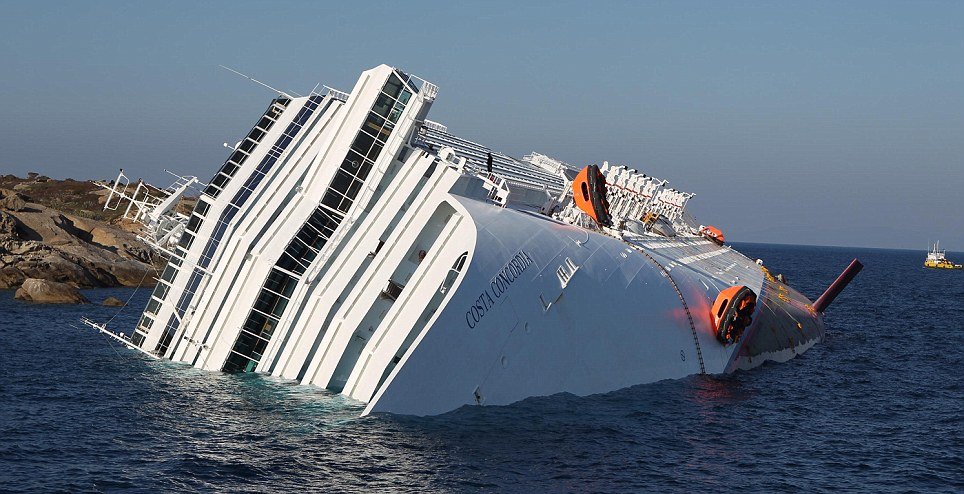
When launched in 2005, it was Italy’s largest cruise ship, measuring 951 feet (290 metres) long with a passenger capacity of 3,780; by comparison, the Titanic was 882.5 feet (269 metres) long and could accommodate up to 2,435 passengers. It featured four swimming pools, a casino, and reportedly the largest spa on a ship. In July 2006 the vessel undertook its maiden voyage, a seven-day cruise of the Mediterranean Sea, with stops in Italy, France, and Spain. The Concordia was supposed to take passengers on a seven-day Italian cruise from Civitavecchia to Savona. But when it deviated from its planned path to sail closer to the island of Giglio, the ship struck a reef known as the Scole Rocks. The impact damaged the ship, allowing water to seep in and putting the 4,229 people on board in danger.
Striking photos as sinking cruise ship Costa Concordia lies in shallow waters
Tragic story of cruise ship disaster than killed 33 passengers - LADbible
Tragic story of cruise ship disaster than killed 33 passengers.
Posted: Thu, 07 Mar 2024 08:00:00 GMT [source]
Seawater was exploding into the engine room and was fast cascading through areas holding all the ship’s engines and generators. The lower decks are divided into giant compartments; if four flood, the ship will sink. His firm, part of the US Carnival group, returned to the ocean again last September, limiting calls to Italian ports, only to suspend operations again in December. The cruise industry has been smashed by the pandemic, suffering a shortfall of 64 billion euros and shedding 518,000 jobs between just mid-March and September last year, according to the Cruise Lines International Association (CLIA). The crew of 1,300 had first observed a 14-day quarantine before reporting for duty.
Costa Cruises and its parent companies
In July 2014 the Concordia—outfitted with a number of steel containers serving as flotation devices—was towed to Genoa, Italy, where it was dismantled for scrap. Through the confusion, the captain somehow made it into a lifeboat before everyone else had made it off. A coast guard member angrily told him on the phone to “Get back on board, damn it! ”—a recorded sound bite that turned into a T-shirt slogan in Italy. Evidence introduced in Schettino’s trial suggests that the safety of his passengers and crew wasn’t his number one priority as he assessed the damage to the Concordia. “Every one of us here has a tragic memory from then,” said Mario Pellegrini, 59, who was deputy mayor in 2012 and was the first civilian to climb onto the cruise ship after it struck the rocks near the lighthouses at the port entrance.
Israeli strikes on southern Gaza city of Rafah kill 22, mostly children, as U.S. advances aid package
About 20 minutes later, even as hundreds of passengers continued to await rescue, Schettino abandoned his post and left his second in command in charge of the evacuation. Twelve minutes later, the latter also abandoned his post, with about 300 passengers still on board. But that version of events did not withstand the scrutiny of the court. At the bottom of the rope ladder, boats took turns picking up the exhausted passengers, helping them jump down the last five or six feet to safety. Giovanni Rossi and his crew alone managed to ferry at least 160 of them safely into the harbor. By one A.M., with the Concordia now lying almost flat on its side, between 700 and 1,000 people remained on board.
Clumps of people were scattered throughout the ship, many clinging to railings. Almost everyone else had congregated in a panicky crowd of 500 or more toward the stern, on the port side of Deck 4, facing the sea. Many of these had taken refuge in a cramped passageway; others remained on the deck outside.

There are going to be substantial risks before the Costa Concordia is gone for good, however. As CNN writes, the ship's rotting hull could break off as it is jostled about, which would cause lengthy delays. "The worst case scenario is that the ship falls apart during the first six hours as it's raised off the platform -- or that it breaks up somewhere off the coast of Corsica, which is where the Mediterranean's currents are the strongest," CNN continues. Some environmental groups, like Greenpeace, are also concerned that the Costa Concordia will leave a trail of leaky toxic waste in its wake, CNN adds. A decade after that harrowing night, the survivors are grateful to have made it out alive. None of the survivors who spoke with Cobiella have been on a cruise since that day.

I began swimming, but every 50 feet I would stop and look back. I could hear the ship creaking and was scared that it would fall on top of me if it capsized completely. I swam for a few minutes and reached the island.” She sat on a wet rock and exhaled. Six hours later the Concordia would be lying on its side in the sea, freezing water surging up the same carpeted hallways that hairdressers and newlyweds were already using to head to dinner. Following the conclusion of the righting operation, the ship was kept on the platform while further inspections were made and the starboard sponsons attached. In a first step to prevent pollution of the shore and assist in a refloat the ship, its oil and fuel tanks were emptied.
What happened to the Costa Concordia? Cruise.Blog - Cruise Blog
What happened to the Costa Concordia? Cruise.Blog.
Posted: Thu, 11 May 2023 07:00:00 GMT [source]
The luxury cruises heading into forbidden Russia and deepest Antarctica
Much of what happened on the night of January 13 can now be told, based on the accounts of dozens of passengers, crew members, and rescue workers. But the one group whose actions are crucial to any understanding of what went wrong—the ship’s officers—has been largely mute, silenced first by superiors at Costa Cruises and now by a web of official investigations. The officers have spoken mainly to the authorities, but this being the Italian justice system, their stories quickly leaked to the newspapers—and not simply, as happens in America, via the utterances of anonymous government officials. In Rome entire transcripts of these interrogations and depositions have been leaked, affording a fairly detailed, if still incomplete, portrait of what the captain and senior officers say actually happened. The MS Costa Concordia, the Italian cruise ship that killed 32 people when it sank off the coast off Isola del Giglio in 2012, has just been sitting off the Tuscan coast ever since. This morning, though, the ship was successfully refloated, the Guardian reports.
Pier Luigi Foschi told a news conference the company would provide its captain with any assistance he required. “But we need to acknowledge the facts and we cannot deny human error,” he added. The Costa Concordia cruise ship ran aground off the west coast of Italy, at Giglio Island on Friday.
“I am not ashamed to say that I pushed people and used my fists to secure a place” for his wife and children, he later told an Italian newspaper. Returning for his parents, Masia had to carry his mother, who was in her 80s, into a boat. When he returned for his father, Giovanni, an 85-year-old Sardinian, he had vanished. Masia ran up and down the deck, searching for him, but Giovanni Masia was never seen again. Somewhere on the ship, an Italian woman named Concetta Robi took out her cell phone and dialed her daughter in the central Italian town of Prato, near Florence.
She described scenes of chaos, ceiling panels falling, waiters stumbling, passengers scrambling to put on life jackets. Schettino’s fourth mistake, however, appears to have been an amazingly stupid bit of confusion. He began his turn by calculating the distance from a set of rocks that lay about 900 yards off the harbor. What he failed to notice was another rock, nearer the ship. Giving orders to Bin Jacob, Schettino eased the Concordia into the turn without event. Then, coming onto a new, northerly course just over a half-mile from the harbor, he saw the rock below, to his left.
The Mediterranean voyage will last from three to seven days, depending on where it stops on the Italian coast - La Spezia, Civitavecchia, Naples, Messina or Cagliari. "Limiting the passage of ships won't solve the difficulties of Venice as a city," he said. Alessandro Santi, who heads Federagenti, a national shipping lobby, said the Italian government was taking no account of the industry and its approach was "regrettable and creates resentment". Those who want the ships to carry on visiting Venice point to the tourism revenue they bring.
It was enormous, just at the surface, crowned with frothing white water; he was so close to Giglio he could see it by the town’s lights. Before leaving port, Captain Schettino set a course for Savona, on the Italian Riviera, 250 miles to the northwest. As the ship steamed into the Tyrrhenian, Schettino headed to dinner with Cemortan, telling an officer to alert him when the Concordia closed within five miles of the island of Giglio, 45 miles northwest.


No comments:
Post a Comment